
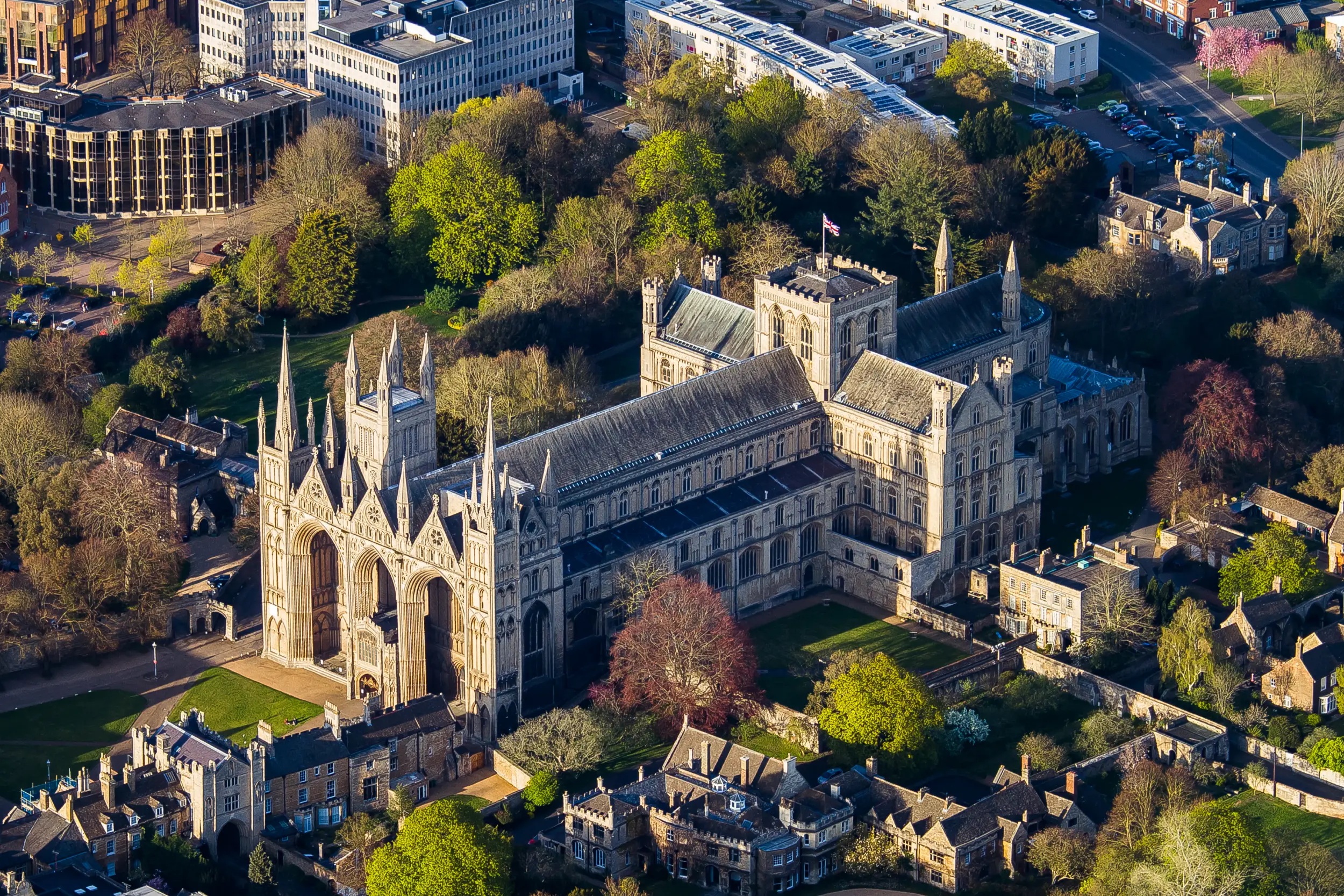

Peterborough Cathedral's stained glass does not tell one continuous story. It survives in layers. Medieval faces and feathers were rescued from destruction and rearranged centuries later, Victorian workshops returned colour to windows that had become plain, Pre-Raphaelite artists brought a radically different visual language into the south transept, and later memorial windows turned the Cathedral's own history into pictures. Taken together, the glass records not simply what Peterborough believed, but what it chose to destroy, recover, remember and create again.
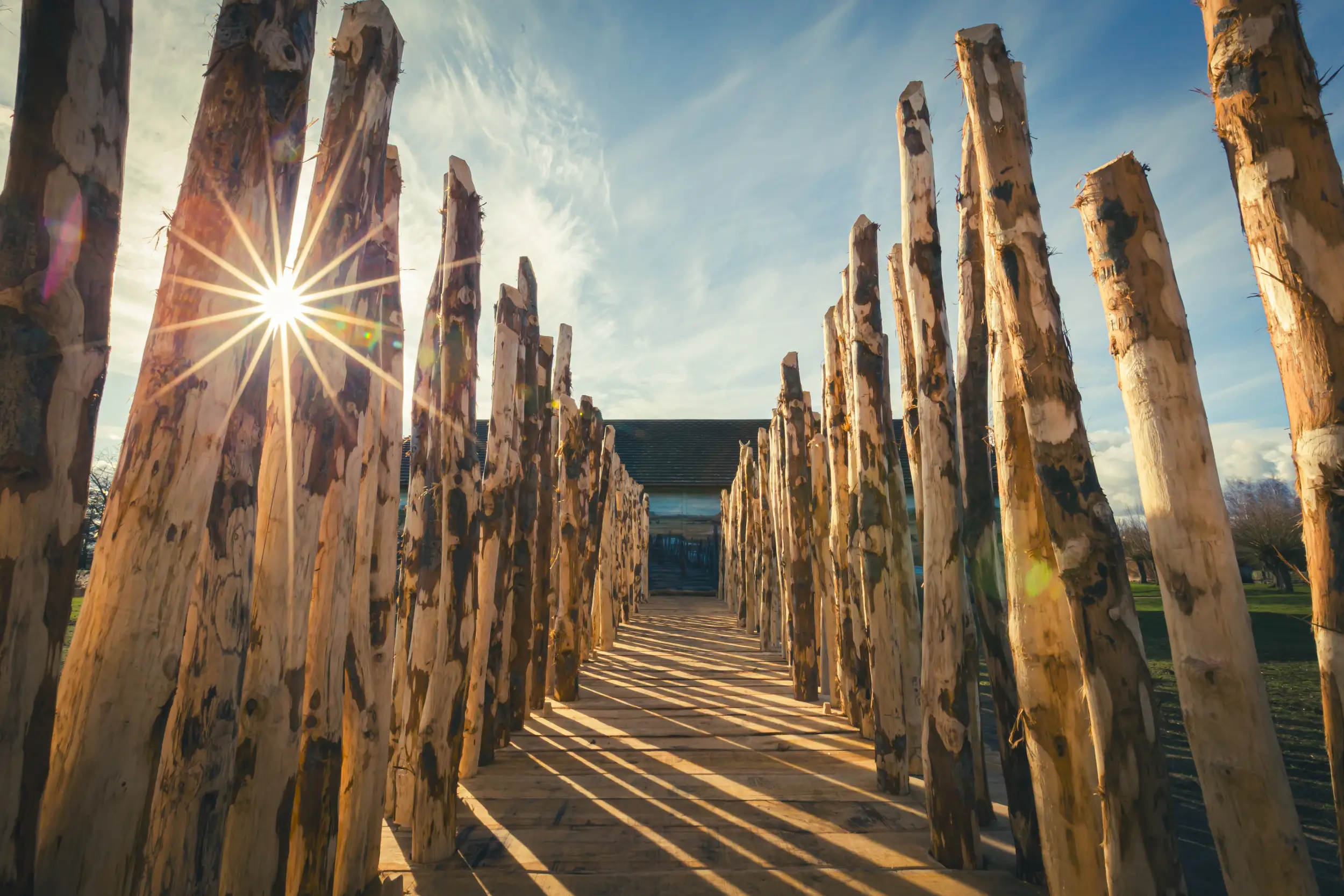
WHEN THE SUN MOVES
Stained glass is not merely decoration applied to architecture. Sunlight passes through the material, turning the window into a changing source of colour within the building itself.
A Cathedral written in light
Stand inside Peterborough Cathedral on a bright day and the building is doing something its stonework cannot achieve alone. It is colouring the light.
We commonly call these windows stained glass, although much of what we see is more accurately described as coloured and painted glass. Colour can be created within the glass itself, while painted detail adds faces, folds of clothing, inscriptions, foliage and tiny narrative elements. Lead holds separate pieces together, but it also becomes part of the drawing, creating the dark lines that give monumental stained glass much of its visual strength.
For medieval worshippers the effect was far more than decorative. Coloured windows transformed an already immense church into an environment of light, image, music and ritual. Biblical stories, saints, kings, heraldry and symbolic creatures could surround people who might never encounter such concentrated colour anywhere else in their lives.
Stone gives Peterborough Cathedral its form. Glass changes the atmosphere inside it.
The story of the windows provides another way into the much longer history of Peterborough Cathedral, a church whose fabric has repeatedly been built, damaged, altered and reinterpreted across more than thirteen centuries.
Imagine the medieval Cathedral filled with colour
The handful of medieval fragments visible today can easily give the wrong impression of the building's original appearance. By the later Middle Ages, stained glass occupied windows throughout the church, and the cloisters were particularly celebrated for their imagery.
The seventeenth-century Peterborough historian Simon Gunton recorded that the cloister glazing once presented biblical history in sequence around its four sides. We no longer have those windows, but his description gives an extraordinary sense of what the monastic complex must once have been like. A person walking through the cloister was not simply passing through an architectural corridor. They were moving through a visual narrative.
Church and cloister windows carried saints, biblical stories, heraldry and devotional imagery.
Faces, foliage, heraldry, letters and pieces of former compositions survive within later arrangements.
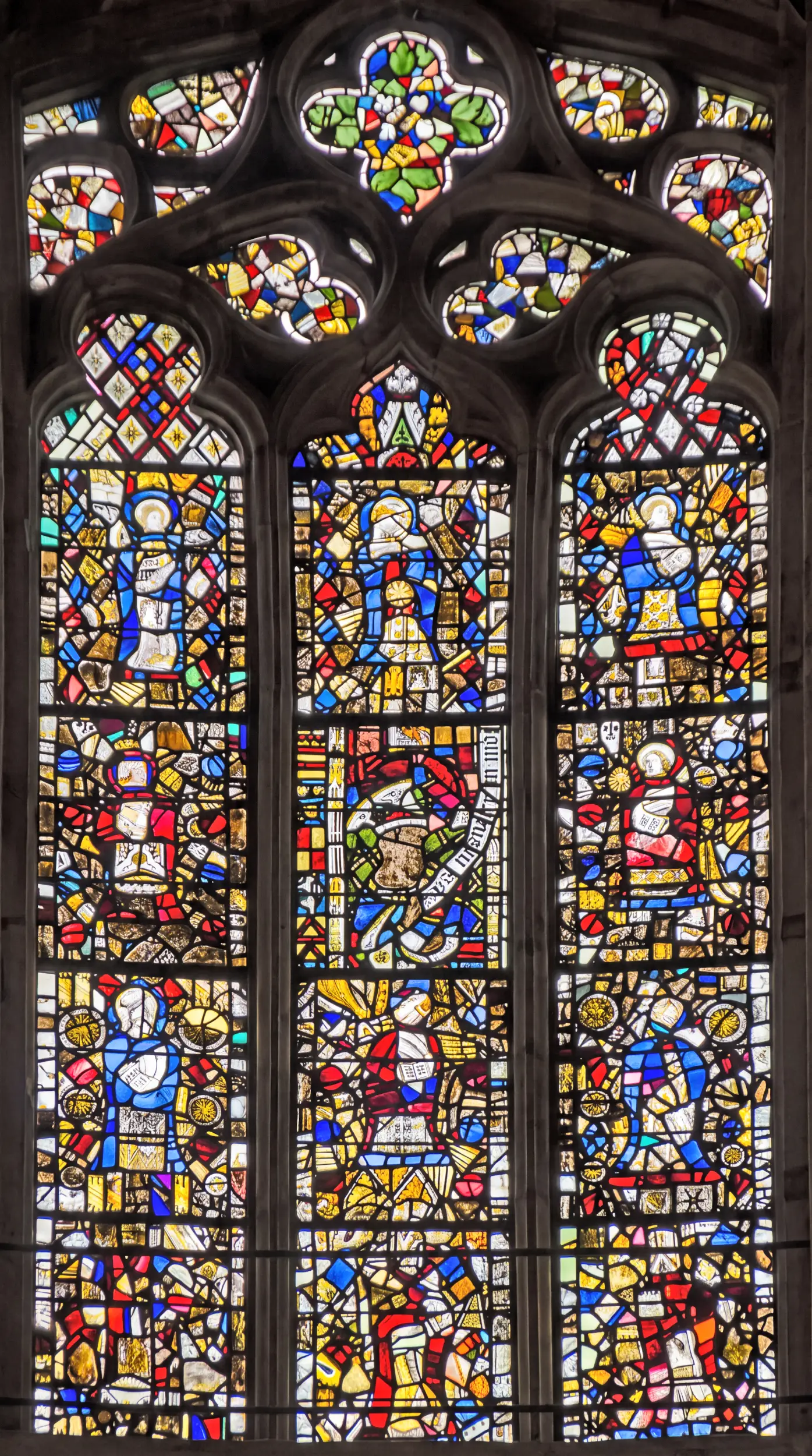
The surviving medieval material can be found high around the eastern apse. Seen from the floor, the fragments can appear almost complete, but closer inspection reveals something more fascinating. Heads do not always belong to the bodies beneath them, decorative fragments have been fitted into new relationships, and pieces once belonging to larger scenes now survive as independent details.
Among them are painted faces, feathers, foliage and heraldic elements. Golden letter forms may have come from the lost Lady Chapel, while royal heraldry provides possible connections with windows that once showed the kings of England.
What survives is not a medieval window. It is a medieval visual archive reconstructed from wreckage.
Then came 1643
Peterborough's medieval glazing survived the Dissolution of the Monastery more successfully than might be expected, but the English Civil War brought catastrophic damage. In April 1643 Parliamentarian troops entered Peterborough while operating against Royalist forces at nearby Crowland, and the Cathedral became a target for iconoclastic destruction.
Contemporary and later accounts describe the organs being smashed, choir furnishings damaged, books destroyed, monuments attacked and religious imagery deliberately defaced. Stained glass throughout the Cathedral and cloisters was broken. Images that had survived religious change in the previous century were now treated as symbols of an unacceptable form of worship.
IN THE WINDOWS BROKE
The story is worth treating carefully. Oliver Cromwell was involved in Parliamentarian operations around Peterborough and Crowland, and traditional Cathedral accounts associate his soldiers directly with the destruction. The larger point is beyond dispute: Parliamentarian iconoclasm in 1643 devastated the Cathedral's surviving imagery, and its medieval glass never recovered as a complete scheme.
Yet destruction did not erase everything. Individual pieces survived, and those fragments eventually became important precisely because so much else had disappeared.
Centuries later, Peterborough began putting the pieces together
During the eighteenth century surviving pieces of old painted glass were gathered together rather than remaining scattered through the building. Cathedral accounts associate Dean Charles Tarrant with the collection and rearrangement of fragments into the eastern windows during the 1780s, beginning the process through which medieval pieces came to be concentrated around the apse.
The result is not archaeological reconstruction in the modern sense. The glass was arranged decoratively, and later material was used where necessary to complete windows. That is why the apse should be read almost like a collage: medieval fragments survive, but their original contexts have often vanished.
But the scene around them may be gone.
But the angel to which it belonged may not.
But only a few characters remain readable.
Detached from the larger composition that once explained it.
This fragmentation is part of the value of the glass. It records two moments simultaneously: the medieval world in which the pieces were created and the later centuries in which Peterborough tried to rescue what remained.
The Victorians put colour back into the Cathedral
By the nineteenth century attitudes towards medieval art had changed dramatically. Gothic architecture, craftsmanship and figurative stained glass were no longer regarded simply as remnants of an old religious culture. They became central to a major revival in church design and decorative art.
Peterborough became an especially interesting place in which to watch that revival unfold because several of the most important stained-glass workshops of the period supplied windows for the Cathedral. Clayton & Bell, Heaton, Butler & Bayne, Burlison & Grylls and other leading firms are represented, while the south transept contains something even more remarkable: work produced by the circle around William Morris and the Pre-Raphaelites.
The remarkable consequence is that the Cathedral now allows different nineteenth-century approaches to stained glass to be compared within the same building. Some windows deliberately evoke medieval precedent through dense colour, Gothic architectural framing and conventional arrangements of saints. Others belong to the new artistic world of the Pre-Raphaelites, whose figures feel more human, dramatic and psychologically immediate.
Rossetti, William Morris and a Peterborough Lord Mayor
The most nationally significant artistic name attached to Peterborough's glass appears in the south transept. The memorial window to Sir Chapman Marshall, a Peterborough-born businessman who became Lord Mayor of London in 1839, was made by the newly established firm Morris, Marshall, Faulkner & Co. in the early 1860s.
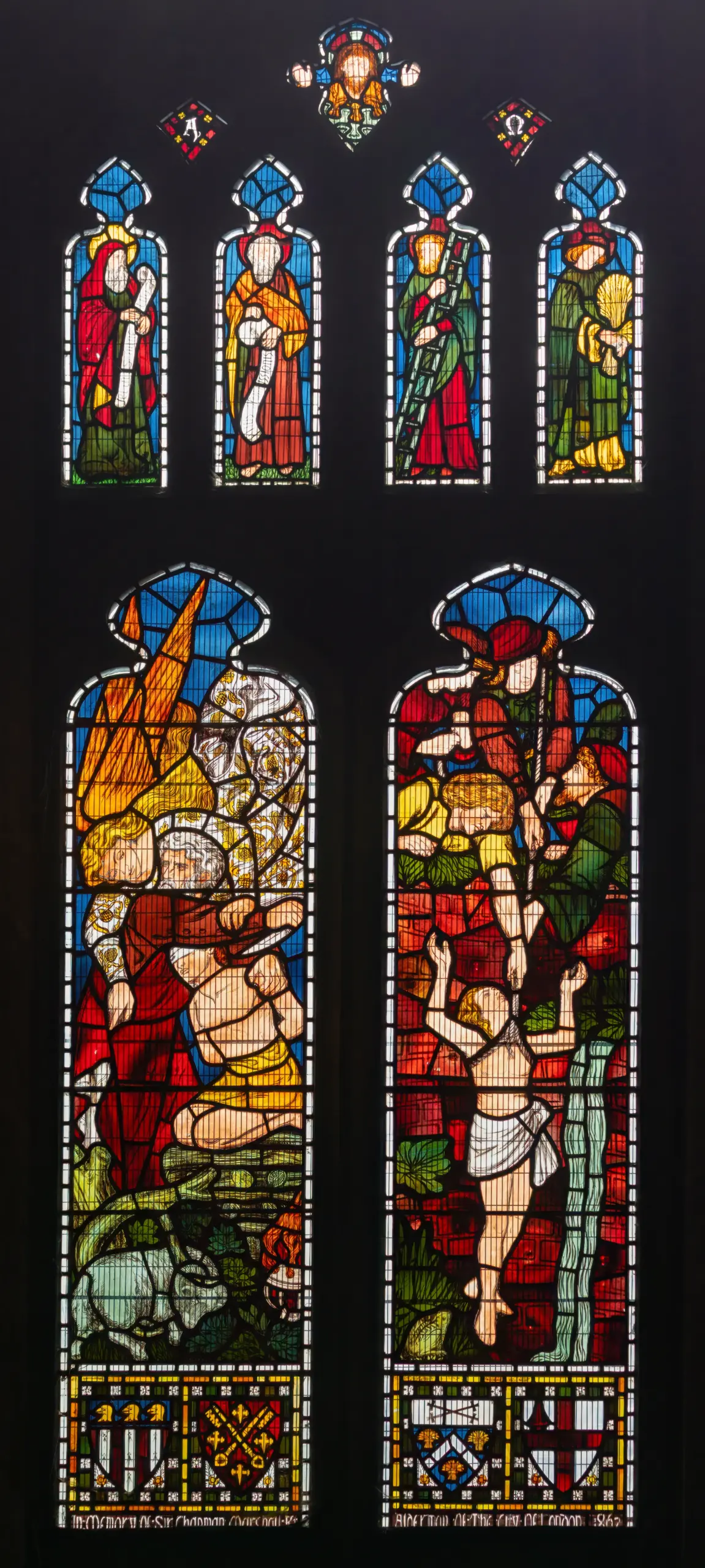
The two major narrative scenes were designed by Dante Gabriel Rossetti. One shows the testing of Abraham through the near-sacrifice of Isaac, while the other depicts Joseph being lifted from the pit after his brothers had stripped him of his distinctive coat. These are not static rows of distant saints. Rossetti turns the biblical stories into scenes of danger, human emotion and rescue.
The window becomes even more remarkable when the rest of its design is examined. William Morris designed saints in the tracery above, while architect and designer Philip Webb contributed heraldic shields below. The result is effectively a collaborative work by figures who were helping to transform British decorative art.
A Peterborough memorial became a canvas for some of the most influential designers of Victorian Britain.
It is an extraordinary connection. A local memorial links Peterborough directly to the early history of a workshop that would become one of the most celebrated names in the Arts and Crafts movement.
Clayton & Bell turned a window into a sequence
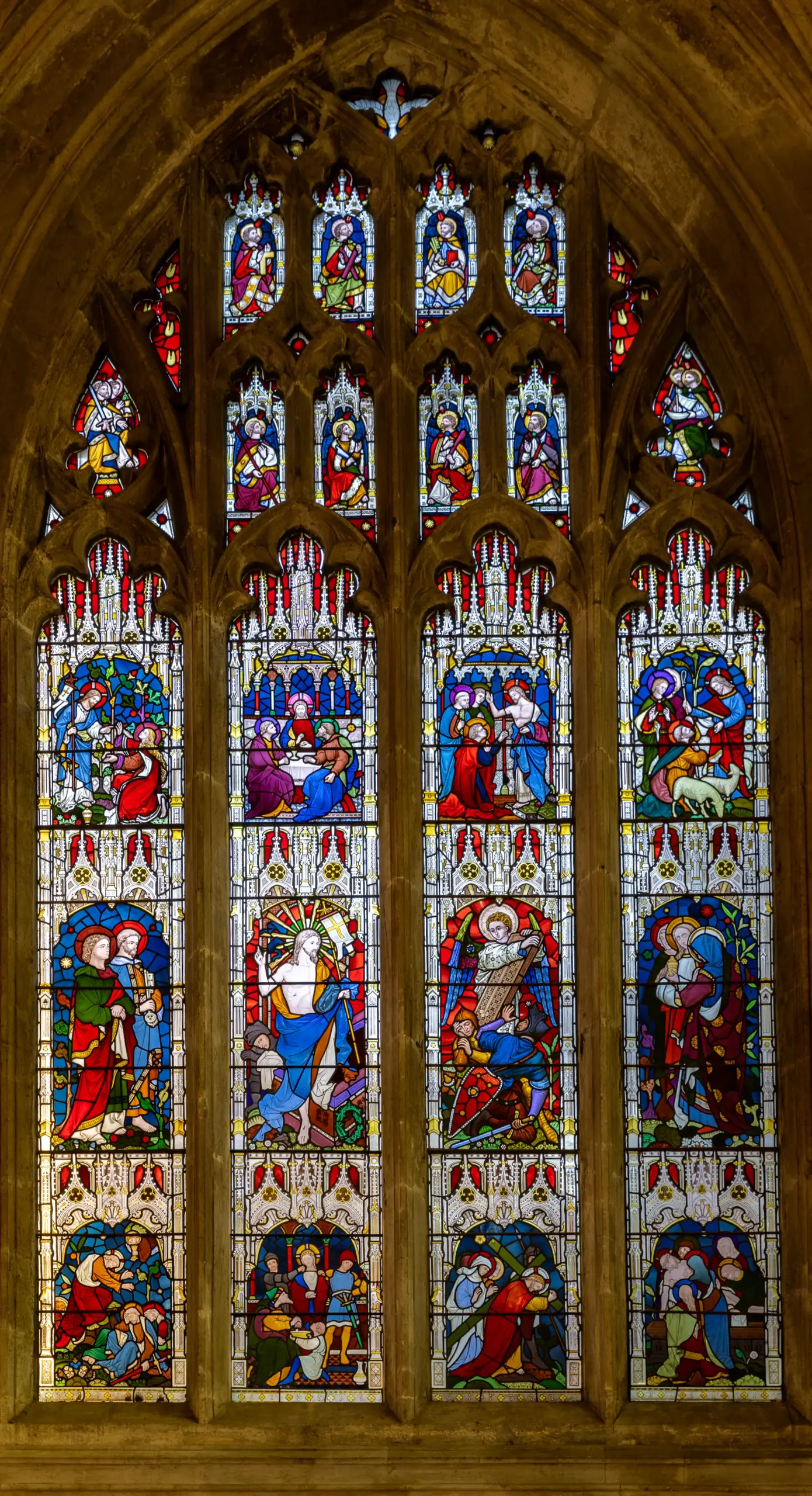
Elsewhere in the Cathedral, Clayton & Bell demonstrate a more narrative approach. Their early four-light glass presents a sequence of scenes associated with the Passion, Resurrection and aftermath of Christ's death, moving through episodes such as Gethsemane, the road to Calvary, the Resurrection, the empty tomb, Emmaus, Doubting Thomas and Pentecost.
In effect, the window asks to be read rather than merely admired. Individual compartments work like illustrated pages, allowing a large theological narrative to unfold vertically through the architecture.
Clayton & Bell were among the most prolific and influential stained-glass studios of Victorian Britain, and Peterborough preserves early work from the period when the partnership was establishing its reputation.
Kings David and Solomon remember Prince Albert
Turn towards the north transept and the atmosphere changes again. Here stained glass fills windows across several levels, creating a wall of colour containing memorials to individuals and families connected with nineteenth-century Peterborough.
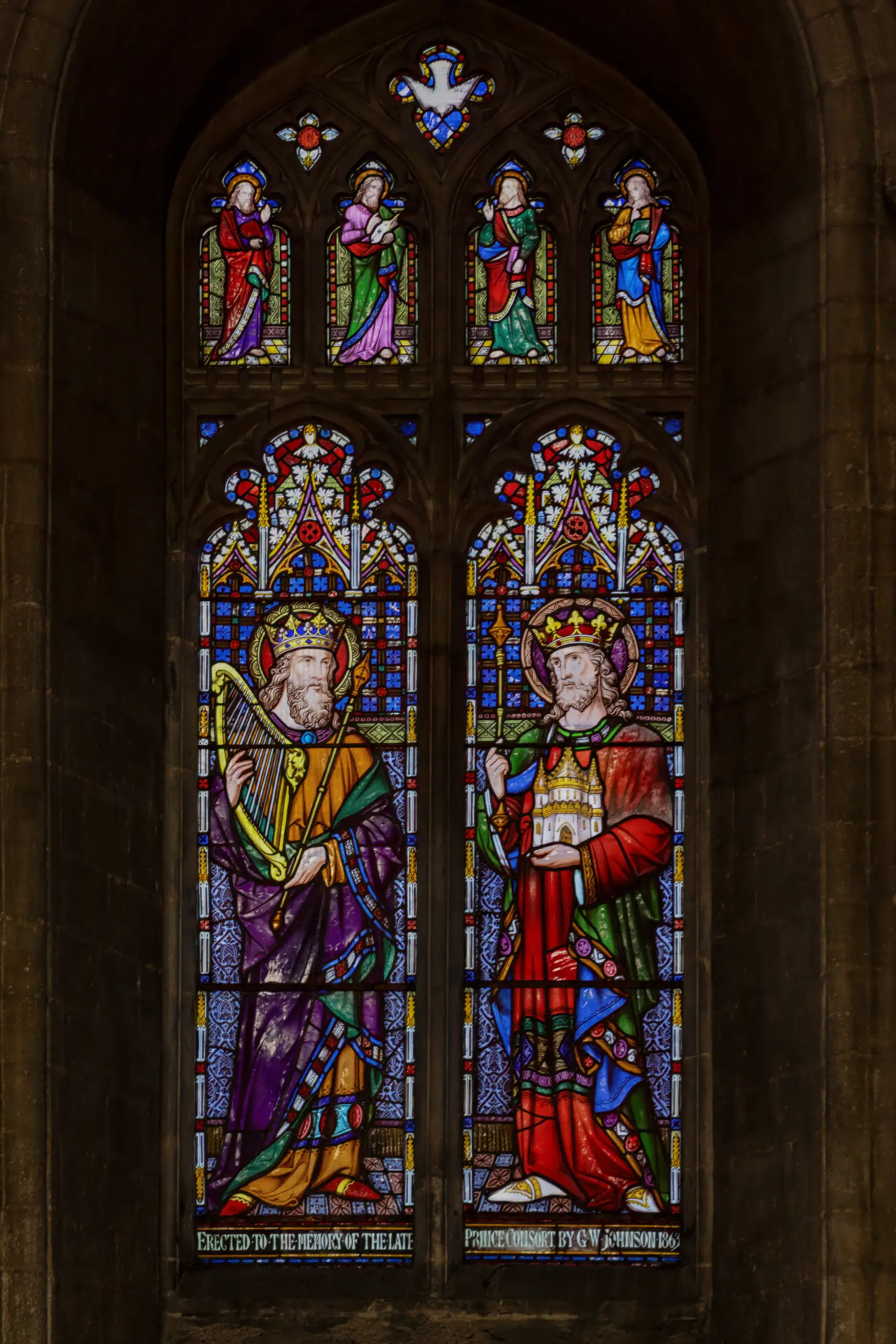
One of these windows commemorates Prince Albert, husband of Queen Victoria, and includes the Old Testament kings David and Solomon. Their presence is particularly appropriate within an ecclesiastical setting: David, traditionally associated with the Psalms and music, and Solomon, associated with wisdom and the building of the Temple, connect kingship with worship and sacred architecture.
The north transept also contains windows connected with the Gates family. John Gates served as secretary to the Bishop, while his son Henry Pearson Gates became Peterborough's first mayor. The house associated with the family in Priestgate later became the city's museum, creating another unexpected thread between Cathedral art and Peterborough Museum & Art Gallery.
The Great West Window is also a war memorial
One of the largest and most immediately visible stained-glass statements in the Cathedral sits above the principal west entrance. The Great West Window, by Burlison & Grylls, was dedicated in 1903 as a memorial to local and Northamptonshire men who died during the South African War.
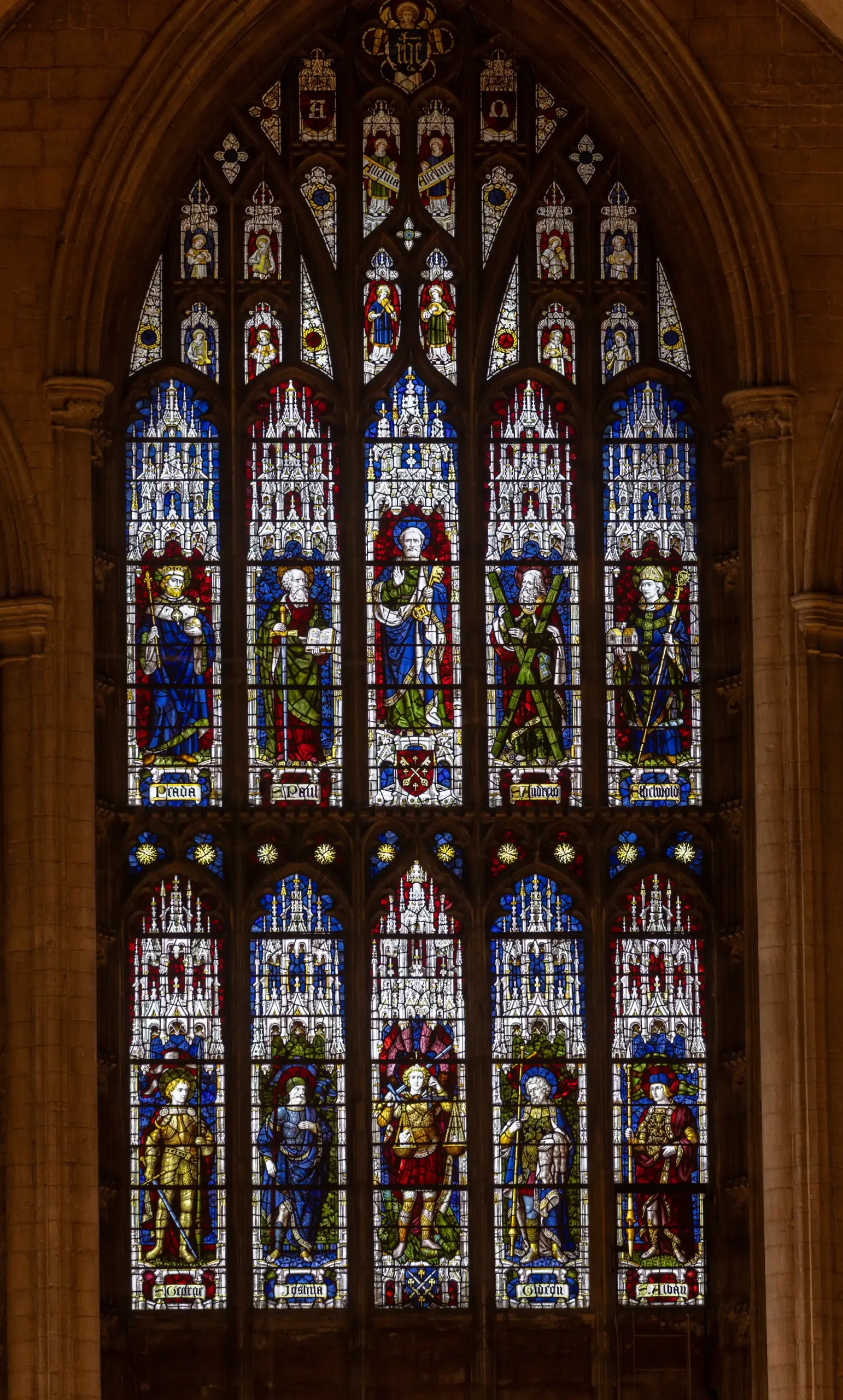
The glass does more than memorialise death. Its figures compress the history and identity of the Cathedral into a monumental visual programme. Among them are St George, St Alban, the Mercian King Peada, St Æthelwold and the Cathedral's three patron saints, Peter, Paul and Andrew.
The Mercian king traditionally associated with the foundation of the first monastery.
The great tenth-century church reformer connected with Peterborough's restored abbey.
The saints whose names define the Cathedral's dedication.
The historic imagery surrounds a modern act of remembrance.
Below the window, brass plaques carry the names of the dead. The architecture, glass and written roll of honour therefore work together as a single memorial ensemble.
In 1958, stained glass began telling Peterborough's own story
Perhaps the most explicitly local narrative window is also among the newest. The east window of St Benedict's Chapel was created in 1958 by W. T. Carter Shapland as a memorial to Bishop Spencer Leeson.
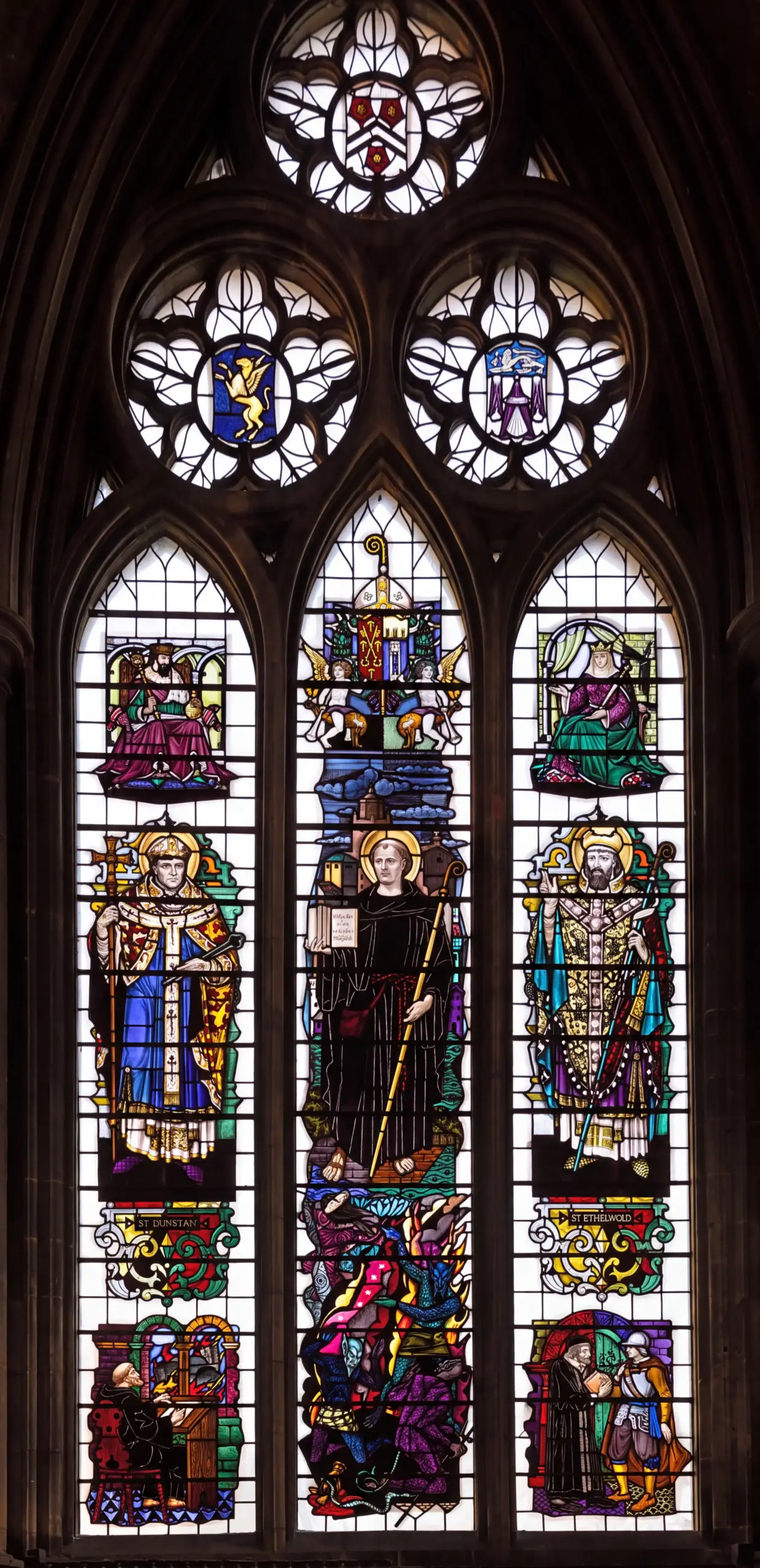
The window uses episodes from the history of Peterborough Abbey and Cathedral to explore a broad struggle between learning and destruction, order and violence. St Benedict appears as the founder of the monastic rule under which Peterborough's medieval community lived, while St Dunstan and St Æthelwold connect the window with the great reforming movement that shaped English monasticism.
Lower scenes bring recognisably Peterborough figures and events into the story. Hugh Candidus, the twelfth-century monk whose chronicle is one of the most important sources for the Abbey's history, is shown in relation to the catastrophic fire of 1116. Another scene depicts Humphrey Austin rescuing a copy of Hugh's chronicle from destruction during the violence of 1643.
There is something beautifully circular about this. A twentieth-century window remembers a medieval historian because his writing survived an episode in which much of the Cathedral's earlier visual art was destroyed. The glass is therefore not merely illustrating history. It is reflecting on the survival of history itself.
How to read Peterborough's stained glass
The best way to look at these windows is slowly. From a distance, colour and overall composition dominate; move closer and individual faces, inscriptions, plants, symbols, heraldry and tiny narrative actions emerge. In some cases the architectural position matters just as much as the picture itself. A memorial above an entrance, a biblical sequence beside an altar or fragments placed high around the apse all behave differently within the building.
Begin with colour, shape and the way the window sits within the architecture.
Saints, kings, biblical characters and local historical figures often identify the purpose of the window.
Many windows are narratives designed to be read from scene to scene.
Tracery, shields, inscriptions and memorial plaques can completely change the meaning of what you see.
Why this belongs in Peterborough in Objects
Strictly speaking, Peterborough Cathedral's stained glass is not one object at all. It is a collection assembled across centuries, produced by different makers for different reasons and repeatedly altered as attitudes towards worship, art and memory changed. That is precisely why it deserves to sit within this collection.
Fragments preserve tiny pieces of an extraordinary visual world that was almost completely lost.
The absence of medieval glass is itself evidence of a violent struggle over religion and imagery.
New glass brought colour back through some of Britain's most important nineteenth-century workshops.
Windows remember Peterborough citizens, bishops, soldiers, monarchs and the Cathedral's own history.
The collection also challenges the idea that heritage is simply whatever is oldest. The medieval fragments are precious because so little survived, but the Rossetti and Morris window is important because it belongs to a revolutionary moment in Victorian art. The Great West Window matters because it records local grief after an imperial war. Carter Shapland's 1958 window matters because it turns Peterborough's own history into modern sacred art.
Every generation has looked at this enormous medieval building and decided what should appear in its windows. Sometimes those decisions added images. In 1643 they removed them. Later generations searched for fragments, rearranged them, commissioned replacements and used glass to tell completely new stories.
The windows do not simply show the history of Peterborough Cathedral. Their survival, destruction and replacement are part of that history.
Look again